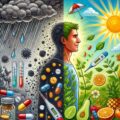
Mold Illness is About Sensitivity NOT Just Toxicity
 Mold Illness Is About Sensitivity, Not Just Toxicity
One of the biggest mistakes in the mold illness world is believing that recovery is simply about GETTING TOXINS OUT OF THE BODY.
Find the mold. Leave the mold. Take binders. Detox harder.
When that doesn’t work, take MORE binders.
But if mold illness were simply a toxicity problem, everyone exposed to the same mold-contaminated building would become equally sick—and removing the exposure and lowering the body’s toxin burden would consistently resolve the illness.
That is clearly NOT what we see.
At EndSickness, we believe one of the most important shifts in understanding chronic mold illness is recognizing that, for many people, the problem eventually becomes much bigger than the mold itself.
The immune system has become SENSITIZED.
The mast cells have become easier to activate.
Inflammatory pathways remain on high alert.
The nervous system can begin associating foods, environments, smells, symptoms, stress and other stimuli with potential danger.
Meanwhile, the regulatory side of the immune system—the mechanisms responsible for saying, “This is safe. You don’t need to attack this.”—may not be functioning optimally.
This is why we believe successful treatment needs to focus not only on reducing exposure and lowering the body’s toxic burden, but on RECONDITIONING THE IMMUNE SYSTEM.
THE GOAL IS NOT JUST DETOXIFICATION
Mycotoxins are real.
Reducing ongoing exposure matters.
Binders can have a place in a comprehensive program.
But a binder cannot teach an overreactive immune system how to tolerate the world again.
A binder cannot, by itself, regulate mast-cell signaling.
It cannot rebuild a disrupted gut microbiome.
It cannot restore every pathway involved in immune tolerance.
And it certainly cannot retrain a nervous system that has spent months or years associating everyday environments, foods and bodily sensations with danger.
This is where we believe many traditional mold protocols are simply TOO NARROW.
The older model has largely centered around:
EXPOSURE → TOXINS → DETOXIFICATION
But the picture can be far more complicated:
EXPOSURE → IMMUNE ACTIVATION → MAST-CELL ACTIVATION → INFLAMMATION → NERVOUS-SYSTEM THREAT RESPONSE → LOSS OF TOLERANCE → MORE REACTIVITY
Once this cycle becomes established, simply trying to pull more toxins out of the gastrointestinal tract may not be enough to stop it.
You have to address:
WHY DOES THE BODY KEEP REACTING?
MAST CELLS MATTER
Mast cells are immune cells designed to protect us.
The problem isn’t that mast cells are inherently bad.
The problem occurs when they become TOO EASILY ACTIVATED.
Someone who once tolerated dozens of foods may suddenly react to food after food.
They may become sensitive to fragrances, temperature changes, supplements, medications, stress, exercise or environments that never bothered them before.
This can create a vicious cycle.
Every new reaction convinces the person that something else is dangerous.
They eliminate another food.
They avoid another environment.
They add another supplement.
They monitor another symptom.
Their world becomes smaller and smaller.
Meanwhile, the immune system and nervous system continue receiving the same message:
DANGER. DANGER. DANGER.
Our objective is different.
We want to gradually help the body rediscover TOLERANCE.
TREGS: THE IMMUNE SYSTEM NEEDS A BRAKE PEDAL
Regulatory T cells—commonly called Tregs—are an important part of the immune system’s braking system.
While other components of immunity initiate inflammatory responses against perceived threats, Tregs help restrain excessive immune responses and maintain immune tolerance.
This distinction is extremely important.
The goal should NOT simply be to “boost the immune system.”
Someone experiencing chronic immune activation may already have an immune system responding too aggressively.
What we want is BETTER IMMUNE REGULATION.
We want an immune system capable of attacking something when it genuinely needs to—but equally capable of standing down when the threat has passed.
That means looking at the entire terrain influencing immune regulation:
Diet.
Gut health.
Sleep.
Stress physiology.
Environmental exposure.
Mast cells.
Inflammatory signaling.
The microbiome.
And the nervous system.
At EndSickness, this is why we favor carefully selected nutritional strategies and supplements that can directly or indirectly support mast-cell stability, inflammatory balance, gut health, antioxidant defenses or regulatory immune pathways.
We are not interested in throwing 30 supplements at an already overwhelmed body simply because they have been labeled “detox.”
MORE SUPPLEMENTS ARE NOT ALWAYS BETTER.
Sometimes the person who reacts to everything needs LESS intervention, not more.
THE GUT CAN HELP TEACH THE IMMUNE SYSTEM WHAT IS SAFE
The gastrointestinal tract has an enormous relationship with the immune system.
This is one reason diet is such an important part of the EndSickness approach.
The objective isn’t to put someone on an extremely restrictive diet forever.
It is to temporarily LOWER THE TOTAL IMMUNE BURDEN while creating an internal environment that supports recovery.
For many people, we emphasize a broad variety of tolerated plant foods and fibers while removing foods that clearly and repeatedly provoke symptoms.
Different fibers and plant compounds interact with the microbiome.
Gut microorganisms produce metabolites—including short-chain fatty acids such as butyrate—that can influence intestinal barrier function and regulatory immune activity.
Think about how important this connection is:
FOOD COMMUNICATES WITH THE MICROBIOME.
THE MICROBIOME COMMUNICATES WITH THE IMMUNE SYSTEM.
THE IMMUNE SYSTEM COMMUNICATES WITH THE NERVOUS SYSTEM.
These are not independent systems.
They are constantly communicating with one another.
This is why simply taking another binder while ignoring diet, gut health and immune regulation makes little sense to us.
YOU CANNOT IGNORE THE NERVOUS SYSTEM
This may be one of the most overlooked parts of mold recovery.
Imagine living for months or years believing that your house, your food, your workplace and sometimes even the AIR around you could make you sick.
Eventually, the nervous system can start searching constantly for danger.
How do I feel?
Is this building safe?
Was that food contaminated?
Is this symptom coming back?
Did I smell mold?
What if this house has mold too?
The brain can become incredibly efficient at detecting anything associated with the original threat.
THIS DOES NOT MEAN THE ILLNESS IS IMAGINARY.
It means the brain, autonomic nervous system, endocrine system and immune system are constantly communicating.
Stress physiology can influence inflammatory and mast-cell signaling.
At the same time, inflammation can influence anxiety, sensory sensitivity, fatigue and threat perception.
One feeds the other.
IT BECOMES A LOOP.
This is why nervous-system retraining is not simply “positive thinking.”
It is about changing the physiological environment in which healing takes place.
At EndSickness, this can include slow nasal breathing, attention retraining, reducing compulsive symptom monitoring, identifying conditioned triggers, changing catastrophic associations and gradually teaching the nervous system:
I AM SAFE AGAIN.
SOMETIMES THE HOUSE CANNOT BE SAVED
Another mistake in the mold world is assuming that every mold-damaged building can realistically be remediated enough for an extremely sensitive person.
Sometimes remediation works beautifully.
Sometimes it doesn’t.
Moisture can exist behind walls.
Under flooring.
Inside HVAC systems.
Within insulation.
Inside wall cavities.
Under cabinets.
Around windows.
Within building materials that cannot realistically be cleaned without major reconstruction.
There are situations where people spend enormous amounts of money repeatedly remediating a property while continuing to feel sick.
At some point, you have to ask:
IS SAVING THE BUILDING MORE IMPORTANT THAN SAVING YOUR HEALTH?
Sometimes leaving is the correct decision.
Moving into a cleaner environment may dramatically lower the total environmental and inflammatory burden and finally give the body room to recover.
But there is another side to this that is equally important.
We do NOT want someone spending the rest of their life terrified of every house, hotel, restaurant, office or public building.
The long-term objective is not perfect avoidance.
The long-term objective is RESILIENCE.
Reduce meaningful exposure while simultaneously increasing the body’s ability to tolerate normal life again.
WHY THE OLD MOLD MODEL NEEDS TO EVOLVE
The Shoemaker Protocol played an important historical role in bringing attention to illness associated with water-damaged buildings, and some individual components may still have value in specific clinical circumstances.
But no protocol should become frozen in time.
Our understanding of immunology has evolved.
Our understanding of mast cells has evolved.
Our understanding of the microbiome has evolved.
Our understanding of regulatory T cells has evolved.
Our understanding of the gut-brain-immune connection has evolved.
Our understanding of neuroimmune communication continues to evolve.
MOLD TREATMENT NEEDS TO EVOLVE WITH IT.
For many chronically reactive people, an approach dominated by binders, biomarkers and detoxification is simply TOO NARROW.
Instead of endlessly asking:
“How do we remove more toxins?”
We need to ask a much bigger question:
WHY CAN’T THIS PERSON’S BODY RETURN TO TOLERANCE?
That question changes everything.
Instead of endlessly attacking toxins, we begin rebuilding the systems responsible for resilience.
LOWER THE ENVIRONMENTAL LOAD.
CHANGE THE DIET AND REDUCE REPEATED IMMUNE TRIGGERS.
SUPPORT THE GUT MICROBIOME.
CALM EXCESSIVE MAST-CELL AND INFLAMMATORY SIGNALING.
SUPPORT REGULATORY IMMUNE PATHWAYS, INCLUDING HEALTHY TREG FUNCTION.
RETRAIN THE NERVOUS SYSTEM OUT OF CONSTANT THREAT DETECTION.
USE SUPPLEMENTS STRATEGICALLY—CHOOSING THOSE THAT SUPPORT THE SYSTEMS WE ARE ACTUALLY TRYING TO REGULATE.
And most importantly:
GRADUALLY TEACH THE BODY THAT THE WORLD IS SAFE AGAIN.
THE GOAL IS NOT TO LIVE IN A BUBBLE
The ultimate goal of mold recovery should never be spending the rest of your life avoiding thousands of foods, buildings, smells and environments.
The goal is getting your life back.
Environmental avoidance may be necessary while someone is extremely sick.
Dietary restriction may temporarily be necessary.
Binders may sometimes be useful.
Mast-cell support may be useful.
Nervous-system retraining may be useful.
Gut support may be useful.
But these are tools.
THEY ARE NOT THE FINAL DESTINATION.
The destination is TOLERANCE.
It is walking into a normal environment without immediately scanning the room for danger.
It is eating a wider variety of foods without fearing every bite.
It is experiencing a temporary symptom without immediately believing you’ve lost months of progress.
It is having an immune system capable of responding when something is genuinely dangerous—and standing down when it isn’t.
This is the fundamental shift behind the EndSickness approach to mold illness.
DON’T JUST ASK HOW YOU CAN REMOVE MORE TOXINS.
Ask how you can create a body that is no longer reacting as though EVERYTHING IS TOXIC.
Because when we stop looking at mold illness exclusively as a detoxification problem and start looking at the entire immune–gut–mast cell–nervous system relationship, we open the door to something much bigger than detoxification.
We open the door to resilience.
Matt Nedin
Certified Holistic Nutritionist
EndSickness, Founder
Phone: (734) 846-8619
WhatsApp: +17348468619
Email: endsickness@gmail.com